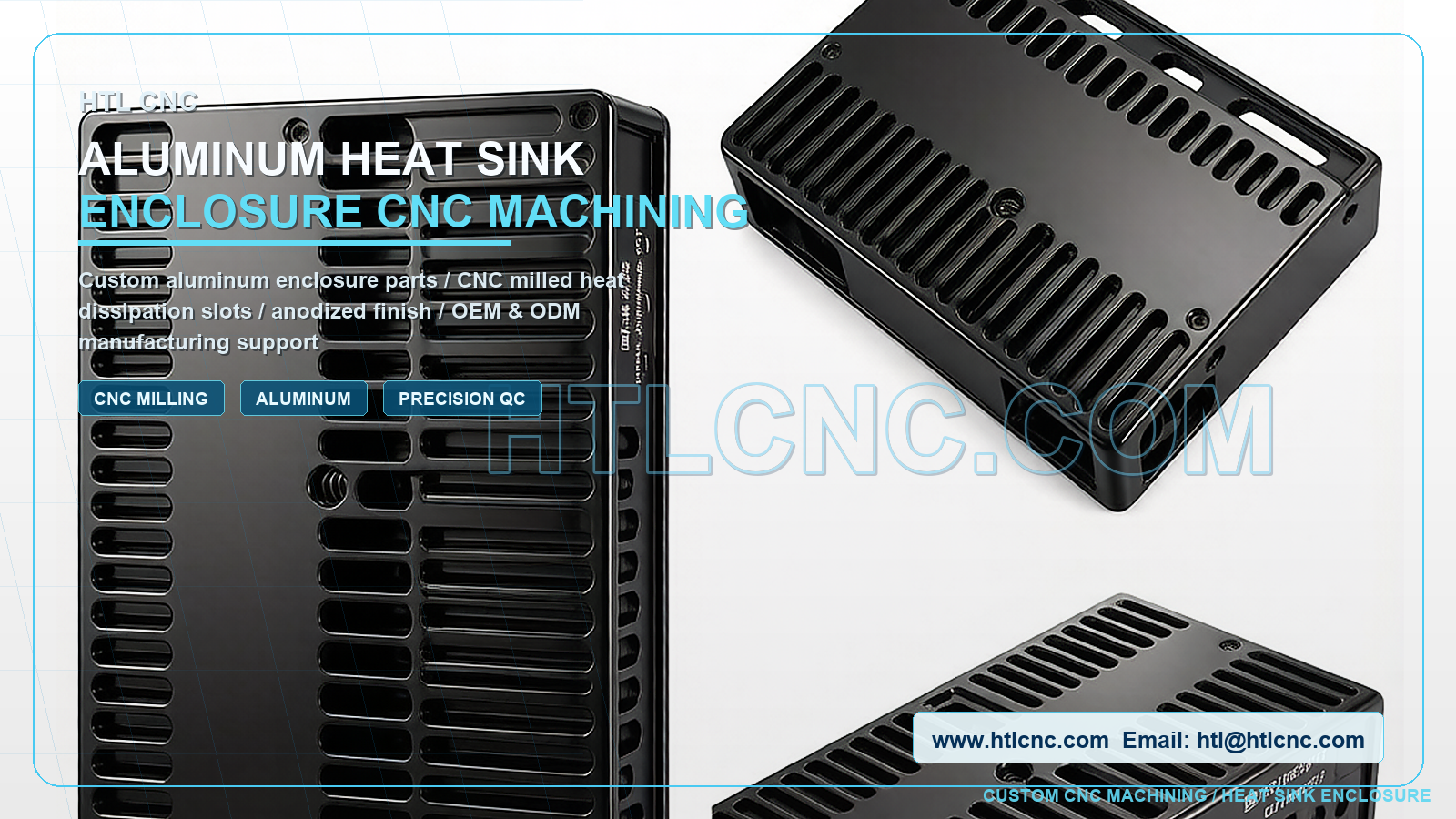
A focused look at black anodized CNC heat sink enclosures with dense cooling slots, precision mounting features and OEM production support for compact electronic hardware.
Compact electronic systems often need the enclosure to perform several jobs at once. It must protect internal components, support reliable assembly, provide connector and fastener access, and help manage heat within a limited installation space. The black metal housings shown here use repeated machined slots across several faces, creating an enclosure architecture designed around ventilation and thermal-management requirements.
HTL CNC manufactures custom heat sink enclosures and electronic equipment housings from customer drawings, STEP files and approved samples. We support prototypes, low-volume validation and repeat OEM production. The final material, alloy grade, thermal design, tolerances and finish are always produced according to the customer's engineering specification.
Dense Cooling Slots Across Multiple Faces
Repeated cooling slots can increase open airflow area and expose more enclosure surface to the surrounding environment. Their actual thermal performance depends on the complete product design, including heat-source location, contact surfaces, airflow direction, internal components and assembly conditions. Machining must therefore follow the customer's validated thermal layout rather than treating the slots as cosmetic features.
When slots are distributed across the top, sides and end faces, process planning becomes important. The machining team must consider tool access, slot spacing, wall thickness, clamping stability and burr removal. Depending on the geometry, 3-axis milling may be suitable for accessible faces, while 4-axis or 5-axis machining can reduce repeated setups and help maintain consistent relationships between features on different sides.
Controlling Wall Stability and Surface Quality
A housing with many openings can lose stiffness during machining. Removing material in an uncontrolled sequence may create vibration, distortion or uneven surface quality. A practical process balances roughing and finishing operations, maintains stable support during clamping, and controls cutting forces around thin walls and narrow ribs.
Edges around cooling slots require careful deburring because they may be visible, handled during assembly or positioned near wiring and electronic modules. Cosmetic surfaces should also be identified clearly on the drawing so handling, inspection and finishing requirements can be planned from the beginning.
Black Anodized Finish for Electronic Housings
Black anodizing is commonly specified for aluminum electronic enclosures when a dark, consistent appearance and improved surface protection are required. The final color and gloss can be influenced by alloy, surface preparation, blasting or brushing, coating process and part geometry. Threads, electrical contact areas, grounding points and critical fits may require masking or dimensional allowance.
Because anodizing changes the finished surface, coating requirements should be confirmed before machining. Drawings should identify cosmetic faces, masked zones, required finish, thread protection and any areas that must remain electrically conductive.
Mounting Features and Assembly Interfaces
Thermal-management housings often include countersunk holes, threaded holes, connector openings, internal pockets and flat mating surfaces. Their positional accuracy affects PCB installation, cover alignment and final product assembly. Inspection should focus on functional datums, hole locations, slot dimensions, flatness, threads and interfaces that contact adjacent components.
Prototype production allows engineering teams to verify fit, airflow, thermal contact and assembly before a larger quantity is released. After validation, controlled programs, repeatable fixtures, finish specifications and inspection points support stable OEM manufacturing.
For a custom black anodized heat sink enclosure or compact electronics housing, send your 2D drawing, STEP file, material, quantity, tolerance, thermal-interface details and surface-finish requirements for review.
Website: www.htlcnc.com WhatsApp: +1 936 358 5257 Mobile: +86 186 8244 4204 Email: htl@htlcnc.com
Have a part ready for engineering review?
Send your drawing, STEP file, material and quantity directly to HTL CNC for a manufacturing quotation.