
 简体中文
简体中文
Published date: June 4, 2026
Source: HTL CNC
As large UAV platforms continue to move from experimental systems into practical industrial applications, the demand for reliable structural and motion-related components is becoming more specific. Heavy-lift drones, agricultural UAVs, industrial inspection drones, mapping platforms and long-endurance unmanned aircraft all depend on lightweight mechanical parts that can support stable rotation, accurate assembly and repeated operation under vibration. Among these parts, the large UAV propeller blade grip, drone propeller holder and related propeller mounting components play an important role in connecting aerodynamic loads with the mechanical structure of the aircraft.
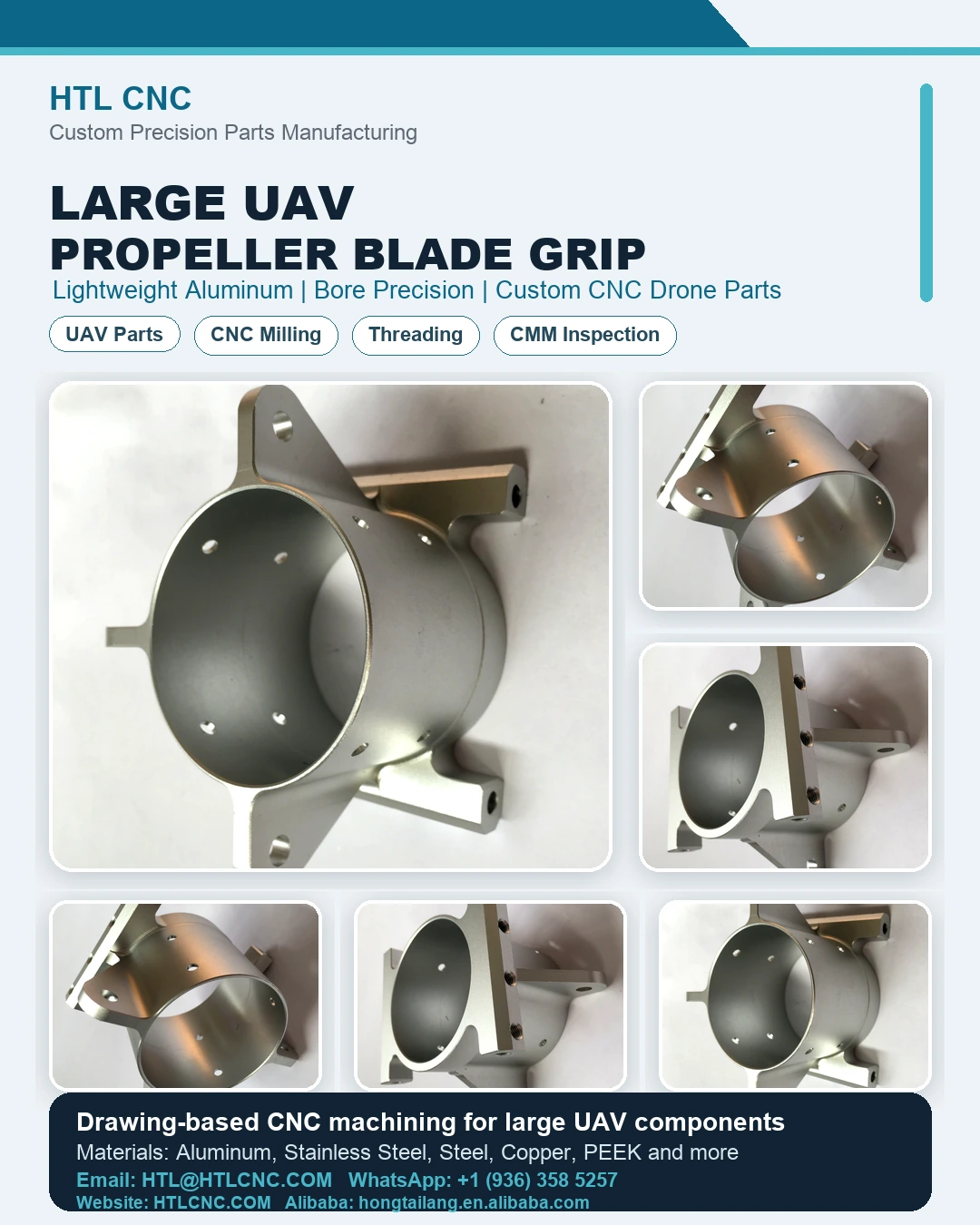
Unlike simple sheet metal brackets or general hardware parts, a large UAV propeller blade grip usually needs a balanced combination of low weight, stable strength, clean surface finish and precise hole positioning. The bore, mounting holes, threaded holes and support arms must match the drawing requirements closely so the part can assemble smoothly with the propeller, shaft, motor or rotor system. If the bore position, hole spacing or surface quality is unstable, it may create unnecessary vibration, assembly difficulty or repeated adjustment during testing. This is why many drone hardware developers and UAV component buyers prefer precision CNC machining for custom aluminum drone parts.
HTL CNC provides drawing-based custom CNC machining services for UAV components, including large drone propeller blade grips, propeller mounts, aluminum brackets, rotor-related structural parts, motor mounting components, lightweight housings and other non-standard precision parts. Our machining capability covers 5-axis, 4-axis and 3-axis CNC machining, CNC turning, CNC milling, turning and milling compound machining, drilling, threading, chamfering and inspection support. For UAV projects that require prototypes, small batches or stable production runs, CNC machining allows engineers to validate mechanical design quickly before moving to larger-volume manufacturing.
For large UAV propeller grip machining, one of the key technical concerns is bore accuracy. The large circular opening is not only a visual feature; it often defines how the part fits with the connected assembly. A clean bore, consistent wall thickness and accurate diameter can help improve installation stability. At the same time, the surrounding mounting holes and threaded features need to remain consistent with the CAD model or 2D drawing. When several holes are distributed around a curved or cylindrical structure, programming, fixture design and machining sequence become important to avoid accumulated dimensional error.
Another important trend in UAV component manufacturing is lightweight structural design. UAV designers often need to reduce unnecessary mass while maintaining enough rigidity for demanding flight and load conditions. Aluminum alloys are widely used in this area because they offer a practical balance of machinability, weight and mechanical performance. Precision CNC machining can remove material where weight reduction is needed while keeping reinforcement areas, mounting ears, flanges and functional surfaces strong enough for assembly. This makes CNC machined aluminum parts suitable for drone propeller holders, UAV motor mounts, support brackets and other lightweight precision components.
Surface quality is also a meaningful factor for UAV parts. For many drone components, a clean machined surface can reduce assembly friction, make inspection easier and support later surface treatment such as anodizing, polishing, sandblasting or other finishing processes requested by the customer. A good surface finish does not replace dimensional control, but it often reflects the stability of the machining process and the attention paid to tool path, cutting parameters and material clamping.
In the current UAV and unmanned systems market, more companies are developing customized platforms for agricultural spraying, logistics, industrial inspection, emergency response, mapping, security and research applications. These projects often require non-standard mechanical components rather than off-the-shelf hardware. Buyers may need a supplier that can review drawings, understand machining risk, support low-volume validation and provide stable quality for repeated orders. For overseas UAV component buyers, the ability to communicate clearly about materials, tolerance, quantity, surface treatment and inspection requirements is just as important as the machining equipment itself.
HTL CNC can process aluminum alloys, stainless steel, steel, brass, copper, magnesium alloys, PEEK and other engineering plastics according to customer drawings and application requirements. For drone-related parts, aluminum alloy machining is especially common, but the final material choice should always follow the customer's drawing, mechanical load, surface treatment requirement and operating environment. We do not define the part function on behalf of the customer; instead, we help convert the supplied design into a stable machined component.
Quality control is essential for components used in UAV assemblies. HTL CNC supports dimensional inspection with measuring tools and CMM inspection according to project requirements. Critical features such as bore diameter, hole spacing, threaded holes, flatness, edge finishing and mating surfaces can be checked before shipment. For customers developing new UAV platforms, inspection feedback can also support design improvement and reduce the risk of repeated prototype revisions.
From a search and procurement perspective, many buyers may use different terms for similar parts, including large UAV propeller blade grip, drone propeller holder, UAV propeller mount, propeller hub component, rotor blade holder, aluminum drone bracket, custom UAV CNC part or precision machined drone component. For this reason, HTL CNC continues to publish industry news and technical articles around real application scenarios, helping international buyers find the right CNC machining partner when they are preparing RFQ packages, drawings or prototype development plans.
If you are developing large UAV propeller blade grips, drone propeller mounts, lightweight aluminum UAV components or other custom CNC machined parts, you can send us your 2D drawings, 3D models, material requirements, tolerance notes, surface treatment needs and expected quantity. Our team will review the information and provide practical machining support for prototype development, small-batch production and OEM custom manufacturing.
Contact HTL CNC
Email: htl@htlcnc.com
WhatsApp: +1 (936) 358-5257
Website: https://www.htlcnc.com/
Alibaba: https://hongtailang.en.alibaba.com/


