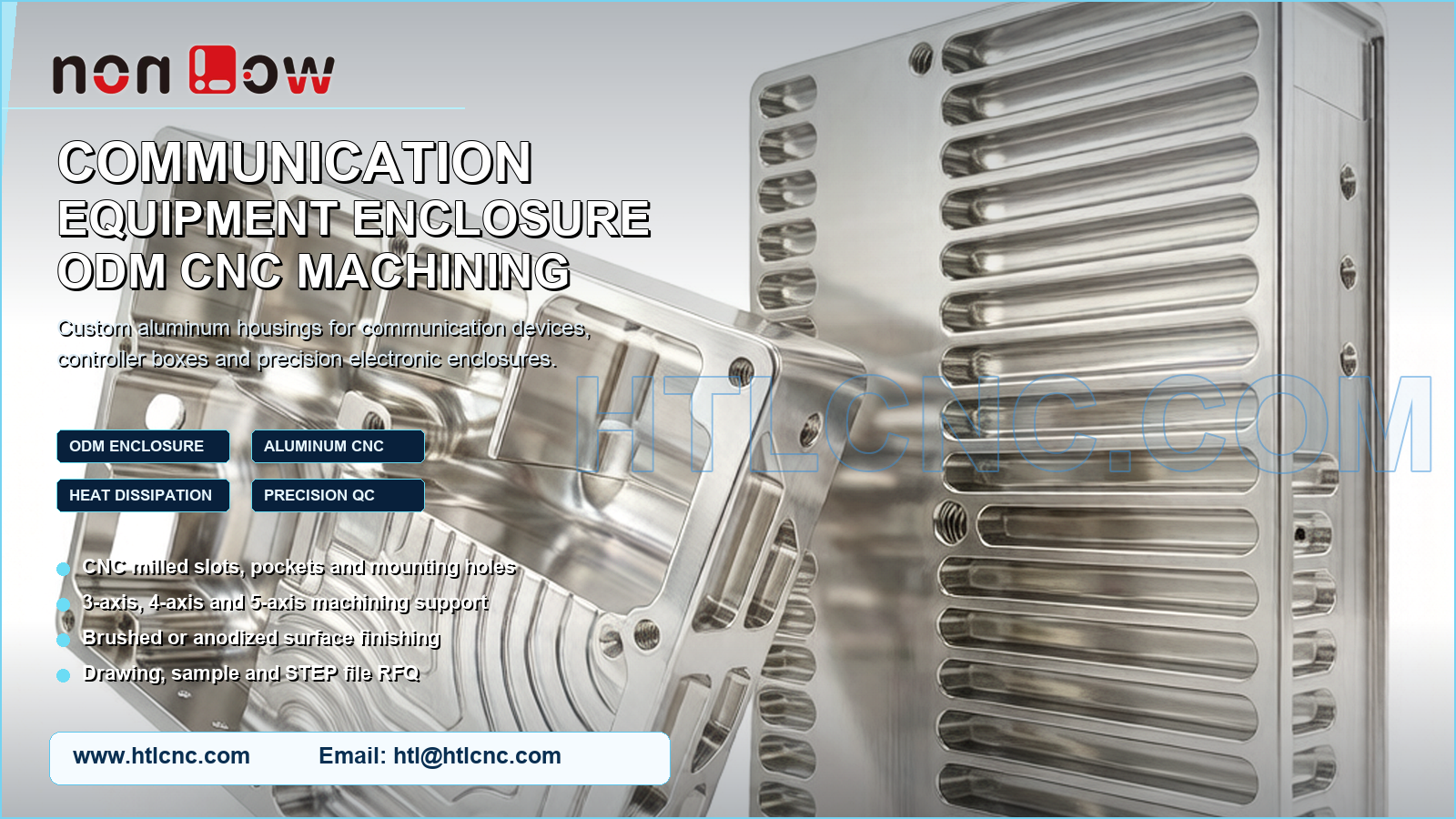
Custom CNC aluminum enclosures for communication equipment with machined cooling slots, precision pockets, threaded mounting holes and ODM production support from prototype to repeat orders.
Communication equipment is becoming more compact while electronic assemblies continue to generate more heat. This makes the enclosure an important functional component rather than a simple protective cover. A well-designed CNC aluminum enclosure can protect internal electronics, support heat transfer, position connectors accurately and provide stable mounting features for final assembly.
HTL CNC manufactures custom communication equipment enclosures from customer drawings, STEP files and samples. Typical projects include telecom housings, controller boxes, RF communication modules, network equipment covers, industrial communication gateways and precision electronic enclosures. We support prototype validation, low-volume production and repeat OEM/ODM orders for international engineering and purchasing teams.
Machined Cooling Slots for Heat Dissipation
Aluminum is widely used for communication equipment housings because it combines low weight, machinability and thermal conductivity. CNC milled slots, external fins, recessed channels and flat thermal contact surfaces can help move heat away from electronic components when they are designed as part of the complete thermal system.
Cooling features must remain consistent across multiple faces while maintaining sufficient wall thickness and structural rigidity. Our engineering review considers tool access, corner radii, slot depth, wall deformation and clamping strategy before production. For complex housings, 4-axis or 5-axis machining can reduce repeated setups and improve the positional relationship between side features, connector openings and mounting surfaces.
Precision Pockets, Threads and Assembly Interfaces
Communication device enclosures often contain internal pockets for circuit boards, threaded holes for covers, connector cutouts, sealing faces and alignment features. These details must match the customer's PCB, fasteners, seals and adjacent components. Unstable hole positions or distorted thin walls can create assembly problems even when the outside appearance looks acceptable.
HTL CNC supports 3-axis, 4-axis and 5-axis CNC milling, drilling, tapping, chamfering and deburring for custom aluminum housings. Critical dimensions can be checked with CMM and other inspection equipment according to drawing requirements. Inspection planning focuses on functional datums, hole locations, pocket dimensions, flatness, threads and mating surfaces.
Surface Finishing for Communication Equipment Housings
Depending on the application and appearance requirements, machined aluminum enclosures can be supplied with brushed, bead-blasted or anodized surfaces. Anodizing can improve corrosion resistance and create a consistent appearance, while laser marking can add model numbers, port labels or traceability information.
Surface treatment requirements should be defined during drawing review because coating thickness, masking areas, cosmetic faces and thread protection may affect the finished part. Confirming these details before machining helps reduce rework and improves consistency between prototypes and batch production.
ODM CNC Machining from Drawing Review to Production
A practical RFQ package should include the 3D model, 2D drawing, aluminum grade, tolerance notes, surface finish, expected quantity and any critical assembly or thermal-management features. Our team can review manufacturability and discuss suitable machining routes before quotation.
For communication equipment enclosure ODM CNC machining, custom aluminum telecom housings, electronic controller boxes or heat-dissipation enclosures, send your drawings and requirements to htl@htlcnc.com. HTL CNC supports engineering samples, small batches and repeat production for global OEM customers.
Have a part ready for engineering review?
Send your drawing, STEP file, material and quantity directly to HTL CNC for a manufacturing quotation.