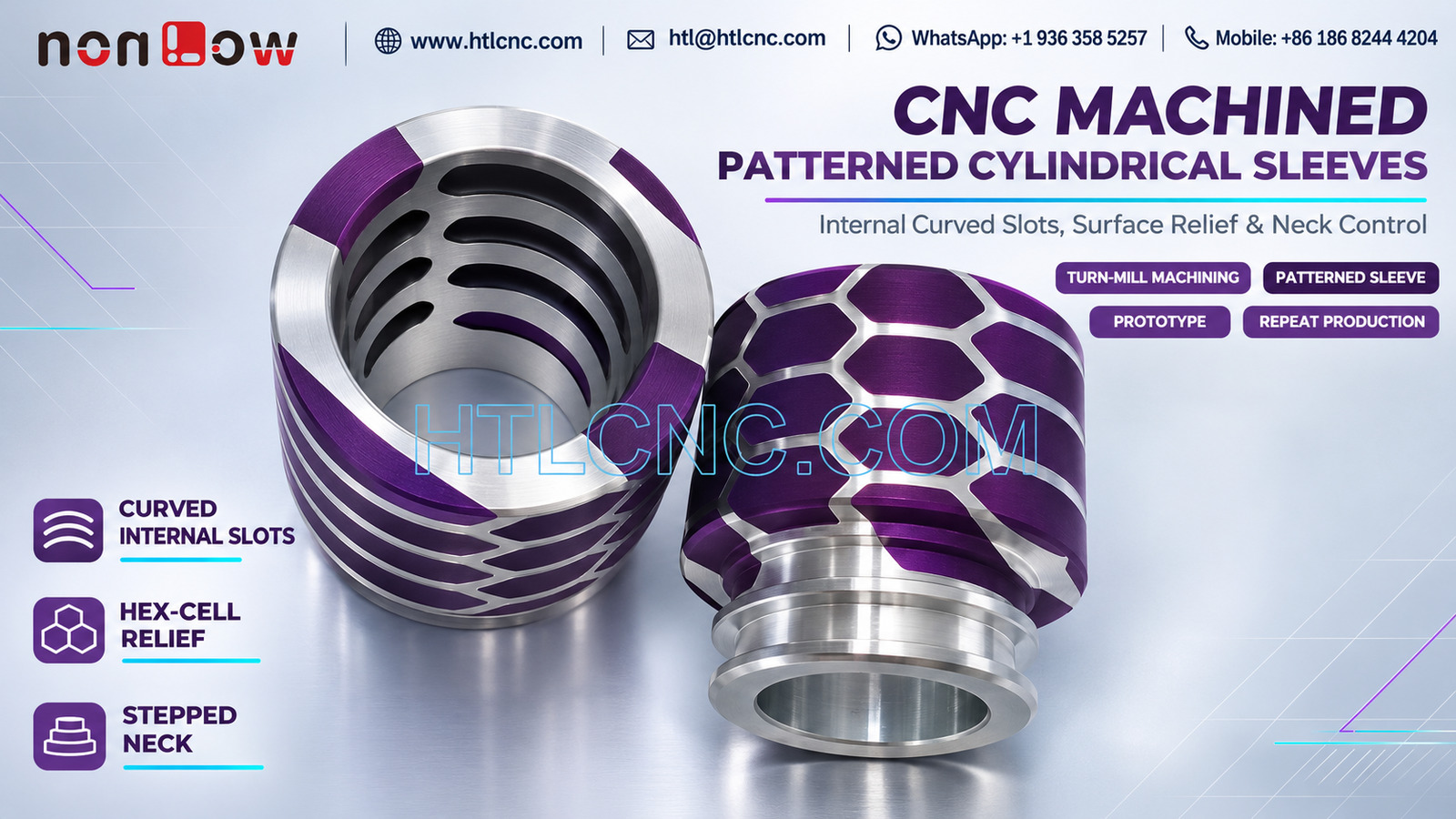
CNC machined patterned cylindrical sleeves combine curved internal slots, alternating exterior relief, hex-cell surface geometry and a stepped neck that require coordinated turn-mill datums and inspection.
CNC machined patterned cylindrical sleeves can combine rotational diameters with curved internal slots, alternating exterior relief bands, hex-cell surface geometry and a stepped neck. The selected photograph shows two samples from one visible family: one emphasizes the bore and repeated curved openings, while the other exposes the exterior cellular pattern and neck geometry. The image does not establish material, coating chemistry, dimensions, tolerances or final application. HTL CNC supports drawing-based custom CNC machining for overseas OEMs, product-development teams and procurement organizations from prototype review through repeat supply.
Qualify the Supplier with a Complete Functional Model
A sourcing package should explain which bore or face locates the sleeve, what enters the central opening, whether the curved slots are functional passages or decorative openings, and how the stepped neck connects to the mating assembly. Simplified mating envelopes can communicate those relationships without disclosing unrelated system details.
Send the released 2D drawing and STEP model together with exact material and condition, quantities, annual demand, finish, inspection-document scope, packaging and destination. HTL's custom CNC machining service reviews the complete definition before selecting stock, fixtures and cutting sequence.
Establish the Main Bore and End Face as Datums
Both samples have a central cylindrical opening and a broad end rim. If those features locate the part, the drawing should define bore size, form, surface condition, edge break and relationship to the seating face. The opposite end and stepped neck should then be dimensioned from the same datum structure.
A bore may pass a diameter check while its axis is tilted relative to the face or outside diameter. Depending on tolerance, verification may use bore gauges, a height setup, CMM probing or a customer-approved functional master. The first-article report should identify measured length and datum setup.
Treat the Curved Internal Slots as a Repeated Pattern
The upright sample reveals several curved slots arranged along the inner wall. Their exact purpose cannot be inferred from the photograph. The drawing should define count, width, axial pitch, curvature, start and stop positions, corner form and angular registration.
Inspection must confirm the complete pattern rather than measuring one representative opening. Optical measurement, CMM scanning or a customer-approved profile fixture may be selected according to slot depth and tolerance. Burrs at the inner edges require controlled removal without widening the slots or softening the bore datum.
Register Exterior Bands to the Internal Geometry
Alternating silver and purple bands form a helical-looking exterior pattern on one sample. Appearance alone cannot establish whether the feature was milled, masked, polished or created by another approved process. The drawing should define the actual machined geometry and any finish boundaries separately.
Where external relief must align with internal openings, a common angular datum is essential. A supplier should not independently center each pattern by eye. The 3D model, drawing and inspection plan need one clocking reference that survives every setup.
Control Hex-Cell Relief without Weakening Local Walls
The angled sample shows a connected hex-cell network across the outer surface. Machining these cells can leave narrow webs between adjacent regions. Tool diameter, corner radius, remaining wall thickness and local support should be reviewed from the released model.
Aggressive finishing or deburring can change the web width and visual consistency. Prototype inspection can compare cell dimensions, boundary transitions and the remaining wall relative to the main bore. If the pattern is cosmetic, the customer should provide an approved visual standard and viewing conditions.
Maintain the Stepped Neck through Reversal
The stepped neck includes multiple cylindrical levels and grooves. The image does not prove that any one groove is a thread. The purchase drawing must state diameters, lengths, groove widths, edge conditions and any actual thread callout.
A turning operation may efficiently establish the bore, end face and neck diameters before indexed milling creates the patterned surfaces. If the component is reversed, a collet, soft jaw, expanding arbor or another qualified fixture may be evaluated. The route must protect finished purple surfaces and preserve axis continuity.
Select Turn-Mill or Multi-Setup Machining from the Geometry
The rotational core suggests CNC turning, while the curved slots and exterior patterns require milling access. A qualified process may combine turning and indexed milling, use turn-mill equipment, or use several controlled setups depending on part size, material, tolerance and quantity. HTL's CNC turning and turn-mill machining service can review those options from the real files.
Reducing setup count can support repeatability, but only when the workholding remains stable and tools can reach every feature. Machine axis count alone does not prove that the internal and external patterns will share the required datum.
Separate Material and Finish Requirements from Color
The purple appearance may come from coating, anodizing, paint, polymer, lighting or another source; the photograph cannot identify it. The purchase order should state the exact substrate, material condition, approved finish specification, color standard, masking, coating allowance, cosmetic zones and certificates.
Silver edges and patterned boundaries may require selective masking or post-finish machining, but the sequence must come from the approved process. The drawing should state whether controlled dimensions apply before or after finishing and which areas require post-finish inspection.
Build First-Article Inspection around Pattern Relationships
A useful first-article report can cover bore and end-face datums, outside diameters, overall length, curved-slot count and profile, external band pitch, hex-cell geometry, stepped-neck dimensions, angular registration, edge condition and drawing-defined geometric tolerances. Gauge IDs, inspection equipment and revision should be recorded.
A related guide to multi-axis custom CNC parts discusses setup selection and datum transfer for components whose features face several directions.
Validate the Prototype in the Real Assembly
Prototype approval should place the sleeve against its actual locating face, insert the mating component through the bore, verify access through the internal slots, and check orientation of the exterior pattern and neck. This sequence reveals cumulative alignment issues that isolated dimensions may not show.
HTL's prototype and low-volume CNC machining service supports engineering samples and pilot lots. Approved corrections should update the 2D drawing, STEP model, finish notes and inspection plan under one controlled revision.
Prepare Repeat Orders and Export Packaging
Repeat production requires controlled material, program revision, fixture identification, cutter-life limits, first-piece release, finish lot control and formal change management. Sharing annual demand and batch size helps plan stock, dedicated fixtures, inspection capacity and delivery cadence.
Packaging should prevent patterned surfaces, silver edges and neck features from contacting adjacent parts. Individual sleeves, formed trays or nonabrasive separators may be selected for the actual finish. Labels should link part number, revision, quantity and lot to inspection records.
RFQ Checklist for Patterned Cylindrical Sleeves
Provide the released drawing and STEP file, mating-interface information, exact material and condition, approved stock form, bore and face datums, curved-slot definition, exterior relief geometry, angular registration, stepped-neck details, any actual thread callout, finish and masking notes, quantities, annual demand, tolerances, inspection documents, packaging, destination and delivery target.
This package allows HTL CNC to quote CNC machined patterned cylindrical sleeves as a controlled turn-mill and inspection program rather than estimating material, finish or function from a photograph. For engineering review and quotation, visit www.htlcnc.com, email htl@htlcnc.com, send WhatsApp to +1 936 358 5257, or call mobile +86 186 8244 4204.
Have a part ready for engineering review?
Send your drawing, STEP file, material and quantity directly to HTL CNC for a manufacturing quotation.